📸 SNAPSHOT - Issue 104
Welcome to a brand new Issue of my Magazine. A truly brilliant one, enjoy the read :)
In partnership with


In this Issue
Tamron’s New 35-100mm f/2.8 Lens Is Here
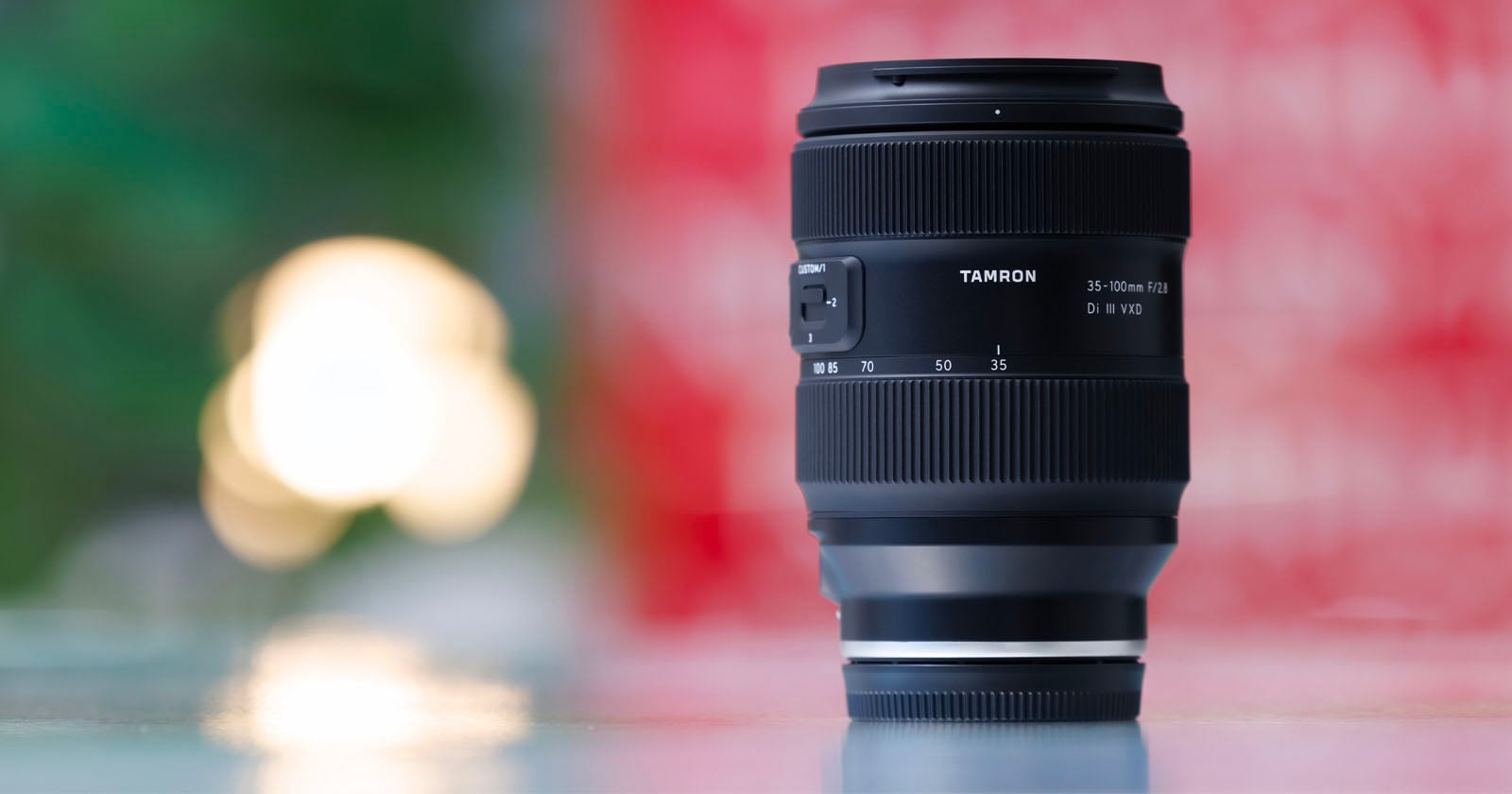
Tamron’s new 35-100mm f/2.8 Di III VXD lens for Sony E-mount and Nikon Z-mount full-frame cameras is here. According to the company, the idea came from feedback on its 35-150mm f/2-2.8 Di III VXD. That lens is widely loved for its image quality and versatility, but it is also big, heavy, and pricey. The new 35-100mm f/2.8 drops some reach (and the faster f/2 wide end) in exchange for something that is much easier to carry and use day to day, while still covering the focal lengths many portrait shooters rely on most.
In terms of size, the lens measures 4.7 inches (119.2mm) long and weighs 565 grams in the Sony version. The Nikon Z version is slightly larger and heavier at 121.5mm and 575 grams. Like many recent Tamron lenses, it uses a 67mm filter thread, which is convenient if you already own other Tamron glass that shares the same size.

Autofocus is powered by Tamron’s VXD (Voice-coil eXtreme-torque Drive) motor, which is designed to be fast, accurate, and quiet. It is not a macro lens, but it can focus surprisingly close, down to 0.22 meters (8.7 inches) at the wide end, which can be useful for tighter shots or detail work.
Optically, the lens uses 15 elements in 13 groups. The aperture range runs from f/2.8 to f/22, controlled by a nine-blade diaphragm. Tamron says the design aims to keep images sharp throughout the zoom range while still producing smooth background blur.

The lens also works with Tamron’s Lens Utility software through a USB-C port on the barrel. With an optional Bluetooth adapter, it can connect to smartphones as well. Tamron recently added iOS support alongside Android for this system.
One interesting change this time around is that both mounts are launching together. In the past, Tamron often released lenses for Sony first, with Nikon Z users waiting months for their version.

The 35-100mm f/2.8 Di III VXD is scheduled to go on sale March 26. Pricing is set at $899 for Sony E-mount and $929 for Nikon Z-mount.
A few sample shots:


Learn The Art Of Photography
Get full and free access to my Creator University - The World’s Best Online University for Photographers & Creatives: Get access to hundreds of amazing photography courses, learn from professional photographers, connect with students and much more!
Interview with Jorge Chagas
This week’s Interview with Jorge, a talented photographer from Portugal. I am truly honoured to have had the opportunity to interview him again, this time with a closer look at his newer work!
You can find him on Instagram as: @jorgemchagas
Enjoy the amazing Interview ;)

Can you tell us a bit about yourself ?
Hello everyone, I'm Jorge, 40 years old, from Lisbon. I'm a web developer, and photography has been a part of my life from a very early age, for as long as I can remember. In university, I had photography classes for 2 years (analog), and that made me want to experiment and use my camera even more.
How did you get into photography?
As I mentioned earlier, photography has always, or from a very early age, been a part of my life. Although I’m a developer today, my background is in design, and imagery, visuals, and the arts have always been my passion. Naturally, photography also became part of my life, starting with those small disposable cameras, up to today’s digital age, and just like that, 25 to 30 years have quickly gone by.

What role does composition play in your photos?
The composition in my photographs usually forms in my mind while I’m observing what I’m about to shoot. Most of my work is street photography, and that has naturally helped me develop this skill because in this type of photography, it’s all about the moment. If you don’t quickly analyze the whole scene, the moment vanishes. Of course, for some photos, to achieve the composition I envisioned, I wait—sometimes for quite a while—until I get the framing or mental vision I’ve imagined. Yes, in photography, a lot is about being patient, experimenting, and failing until the effects we desire truly start to appear.
What do you think sets your work apart from others in the industry?
Nowadays, with so much information available to everyone, the digital age and social media have made this possible, and that’s a good thing, what sets me apart from others, in my opinion, is primarily the way I like to approach and capture light. Lisbon, being my home and having such fantastic light, which has always fascinated me, plays a big role. Every time I go out to observe and photograph, that fascination remains the same, and I never get tired of it. Next, for me, it’s about the people. I mostly photograph in the morning because, as I mentioned, the light in Lisbon is special, and in the early hours of the day, the people are primarily locals, the true Lisbon inhabitants. These are the people who shape the city and make each place unique.

How do you stay inspired and motivated to continue creating new and unique photographs?
What motivates me, first and foremost, is this passion for photography and capturing unique moments—I can’t even imagine my life without these moments; it’s something that feels natural to me now. Of course, there are periods when inspiration is low, and demotivation sets in, when things don’t go well or feel right. That side is rarely shown—where we take thousands of photos and end up liking only a small percentage of them. But it’s during those times that it’s important to stay resilient and keep doing what we love; that’s what ultimately sets us apart. Photography is a lot about trying, trying, and trying again until we eventually find our direction. Nowadays, inspiration comes in many forms, with so many great photographers being accessible to everyone. They bring me so much value and essentially push me to evolve and give even more of myself—first, to prove that I’m equally capable, but also to showcase my work and, in some way, keep up with them in a healthy competition.
What are some of the most important qualities for a great photographer to have, in your opinion?
Above all, a great passion for photography, being able to do what we love should already be a differentiating factor because not everyone has that privilege. Next, be persistent and resilient. We will fail many times compared to the times we get it right, and that’s part of the process. Over time, this process will shape the photographer you become and what you enjoy in photography. And experiment, a lot. Grab your camera and shoot. I know it’s a cliché, but it’s the reality. Nowadays, the equipment is fantastic, but that differentiating factor has everything to do with the drive to do more.

What gear do you use?
Currently, I use an "old" Canon EOS R that I love; it’s been my companion for many years and has never let me down. I’m considering an upgrade, but I’ll say it again: don’t focus too much on the gear—the difference lies within you. As for lenses, I have a few zooms, 24-70mm, 70-200mm, and some primes, which are my favorites: 50mm, 85mm, and 35mm, the classics.
What is your editing software of choice and how much time do you spend editing?
For editing software, I primarily and almost exclusively use Lightroom; I rarely need Photoshop, only in very specific cases. The editing time varies quite a bit—some photos take 5 minutes, while others can take up to an hour. It all depends on how the photo turned out from the camera or how you envisioned that particular shot in your mind.

How did you find your signature photography/editing style?
This happened naturally. My "style" is closely related to what I like—the light and the contrast with shadows. Capturing the everyday life of my Lisbon, especially the people who bring this city to life. As I mentioned before, we all have influences from other photographers; we take what we like from each of them and add it to our own style. Each of us sees the world differently, which means that each of us has our own style. We might take the same photo with the same framing, but in the end, all the photographs will be different.
Reels or photos? And why?
I’m a photography person; I always have been, which is why my answer is quite simple and direct. I have nothing against video/reels, but it’s just that photography is what fulfills me and what I love.

What does photography mean to you?
Photography means being able to show everyone how I see the world around us, and that we all have a unique way of seeing and capturing things. In the previous answers, I’ve already mentioned much of what photography means to me, but the main thing is really to capture and share "my world" with everyone.
How would you describe your photography style in a few words?
In a few words, my type of photography is a constant interplay between light and shadows, with people playing the central role. Photography captures moments, and when we remember the good times, it's always the people that matter most. I must also mention that much of my style reflects what Lisbon is to me and everything it represents.

Do you prefer shooting alone or with company?
I’m part of the "alone" team; sometimes I photograph with friends, but mostly on my own. When I photograph with friends, I try to keep the group small. Photography, for me, requires concentration and focus, and observing with many distractions becomes an even greater challenge. There’s nothing against larger groups; it’s just my way of experiencing and living photography.
What are your thoughts on AI in photography?
Regarding AI, I prefer not to call it photography but rather digital art. From my perspective, a photograph is not just the result of an action; for me, photography involves the entire experience of going out, exploring, observing, and using your camera. This experience is missing with an image produced through artificial intelligence. As I mentioned before, it's not about being against it; it’s just that things belong to different categories, in my opinion.

Any tips for beginners?
My main recommendation is to be curious and resilient. The results you expect won’t come right away; you’ll need to explore, go out into the streets, stay attentive to your surroundings, and observe, observe, observe. The eye is something that requires a lot of training, just like most things we are already good at, but where we can always improve. And finally, never give up on your passion, on what makes you get up before the sun has risen or endure a huge downpour. If it drives each of us, it’s because it is truly special. Only something that is special has that effect on us humans.
What is your dream equipment?
I don’t have what I would call dream equipment. I’ve always used Canon simply because when I started with photography, it was the brand I chose for my first camera, and like with all relationships, it worked out well, so it’s been Canon ever since. That said, I would love to try the new Canon R5 Mark II or a Canon R1. However, if I were told I could only have one camera, I would love to try or acquire a Leica.

Are you a professional photographer or is it just a hobby?
It’s just a hobby, and I love that it remains a hobby. I say this sometimes to friends: if it were a professional pursuit, the passion and the magic of being able to photograph what I want, how I want, and when I want, could be lost. There was a possibility of turning it into something professional, but it didn’t work out. Maybe one day, who knows...
How important is social media for photographers?
Nowadays, it's very important, as it is for many other things, given that we live in the digital age. These platforms are a great way to showcase our work to others. The visibility gained through social media is huge, and that’s very important for a photographer as well. However, having a website/portfolio where people can view your work in a more professional manner is something every photographer should keep in mind.

Is AI going to replace photographers?
I don’t believe that any AI can replace a photographer. It will help and enable achieving results much more quickly and efficiently, but I don’t think it will replace a photographer. The emotional, human aspect behind a photograph cannot be replicated. A photographer is not just someone who presses a button and produces an image; the interaction, experience, and contact that are part of a photographer’s daily life with people will never be lost.
How important is storytelling compared to aesthetics?

The rest, 5 more questions of this Interview + an additional exclusive photograph selection, are for Premium subscribers only.
WD Is Reviving And Relaunching The G-Drive

Now that SanDisk has been spun off into a separate company again, Western Digital, now just calling itself WD, is putting new energy into the G-Drive brand and moving over the HDD products that used to sit under the SanDisk Professional label.
The split last year left WD focused purely on traditional hard drives, while SanDisk kept the SSD side of the business. Since WD cannot use the SanDisk Professional name anymore for creator-focused HDD gear, it is dusting off G-Drive, a brand that has been around for years but has not seen much attention lately.

The “G” name actually goes back to the old G-Technology lineup, which many photographers and filmmakers will remember for its RAID systems and rugged external drives. Over the past several years, SanDisk became the face of creator storage, and G-Drive more or less faded into the background. Now WD is bringing it back as its main brand for creatives.
The refreshed lineup launches with five new or updated products, covering everything from portable drives to serious multi-bay systems.
The only portable model at launch is the G-Drive ArmorATD, a rugged external hard drive available in capacities up to 6TB. It is built with triple-layer shock protection, an aluminium shell, and IP54 dust- and water-resistance. The 6TB version costs about $240, with smaller options priced lower.

Next is the standard desktop G-Drive, a high-capacity external HDD that uses WD’s enterprise-class Ultrastar drives. It goes up to 26TB and is meant for big photo libraries, video projects, backups, and long-term storage. Prices run from roughly $275 for 6TB to around $750 for the 26TB model.

WD is also rolling out the G-Drive Project, a single-bay Thunderbolt 3 desktop drive designed for higher performance. It uses the same Ultrastar hardware and also tops out at 26TB. Pricing starts at about $425 for 6TB and reaches around $1,000 for the largest capacity.

For people who need more speed or redundancy, the G-Drive Project 2 adds a second bay in a compact RAID enclosure. It ships in RAID 0 by default and supports user-replaceable drives, with total capacity up to 52TB.

At the top end, WD is bringing back the Shuttle name with the G-RAID Shuttle 4 and Shuttle 8, transportable multi-bay storage arrays for production work. These use hot-swappable Ultrastar drives and come configured as RAID 5 out of the box. The four-bay version supports up to 104TB, while the eight-bay model goes all the way to 208TB, clearly targeting on-set data wrangling and multi-camera workflows.
Pricing starts at $2,670 for the 24TB Shuttle 4 and $4,335 for the 48TB Shuttle 8, with fully loaded versions reaching $5,000 and $9,225 respectively.

WD says existing SanDisk Professional HDD products will still be supported and covered under warranty, but from here on out, new hard-drive-based gear for creators will carry the G-Drive name instead.
Photography Tip of the Week


The weekly photography tip is only accessible to Premium Subscribers of The Magazine For Photographers.
Photo Analysis
Welcome to the part of the Magazine Issue where we take a closer look at a photo and analyse it so that you can learn and better your own photography from it ;)
Photo by: @donamtykl

Let’s Analyse this Photo
Composition & Framing
What works well:
What we can see immediately is that the structure and layering here are the most key detail and the star of the show. Your eye naturally moves through the photo step by step → first the cyclist, then the lower train, then the upper one, and finally the train at the very top. That progression alone creates a huge sense of depth, complexity, visual interest.
Even though the background is cluttered with wires, poles, and urban chaos in further back, the strong layers keep everything in check. Your eye knows exactly where to go (you have the option to explore further if you wish, but on a first look the photo is straight forward and not ‘‘confusing’’ or ‘‘overwhelming’’).
The cyclist acts as a good foreground anchor. Small yes, but very important for scale.
The diagonal, more modern train adds some dynamic energy (because it diagonal obviously and thus ‘‘cuts through’’) → breaks up the otherwise horizontal composition.
What could be better:
It is still a very busy frame at the end of the day. Without that strong layering, it would probably feel too cluttered.
The cyclist is close to the bottom edge and could use a bit more breathing room, light and ‘‘size’’.
There is not one single dominant subject, it is more of a stacked scene of subjects competing for attention. However to be fair, this is also kind of the point.
Light & Atmosphere
What works well:
The warm, late-day light softens what would otherwise be a harsh, industrial looking scene. It gives the concrete and some other surfaces, especially on that middle train, a nice glow instead of a cold look.
The sky adds mood without stealing much attention away. It is dramatic enough to be interesting, but not so intense that it competes with the rest.
The highlights along the modern train in the middle help separate it from the structure behind/below/next to it and make it feel dimensional/ “pop” out stronger.
What could be better:
The lower part of the frame sits in relatively heavy shadow, which hides detail in the street and around the cyclist.
The general brightness/more “shine” up top pulls attention slightly away from the layered action below.
A touch more light on the cyclist would strengthen the visual entry point into the scene and similar to the middle train make him “pop” more.
Emotion & Story
What works well:
This feels less like a character-driven story in the typical sense and more like a “rare visual moment.” The fact that all the trains and the cyclist align at once makes the scene special.
The distinct trains give a strong sense of place, even without a lot of context. Anyone familiar with train systems will immediately recognize where this might be. There is also a sign in the bottom left with distinctive writing, telling us that this is Bangkok, Thailand.
What could be better:
The cyclist is too small to convey personal emotion or any narrative detail.
As I mentioned before, it reads more as a visually impressive moment than a “story” (and not everything needs to be a story).
Colour & Tone
What works well:
The warm sky contrasts nicely with the cooler greys of the concrete.
The orange train at the very bottom has a strong color accent that further grounds the lower half of the frame.
The modern train’s neutral tones keep it sleek and believable rather than flashy.
What could be better:
The palette leans heavily warm in the upper half, making the lower section feel comparatively muted.
Gere and there, some midtones in the concrete structures feel slightly flat.
A bit more separation between the different train colors could help with readability even more (especially the one at the very top).
Balance
What works well:
The stacked composition balances vertically with -> sky, top train, middle train, lower train, cyclist.
Bright elements above are more or less counterweighted by darker, heavier elements below.
The cyclist provides a small but essential grounding point.
What could be better:
The upper portion still dominates visually due to brightness and sheer scale.
The right side carries slightly more visual weight because of the middle train’s length, scale and shine.
Join Our Photographer Group!

Get access to the best photographer group/community for networking, collaborating, gear talk, feedback on your work and so much more!
Something You Have To Check Out
Every headline satisfies an opinion. Except ours.

Remember when the news was about what happened, not how to feel about it? 1440's Daily Digest is bringing that back. Every morning, they sift through 100+ sources to deliver a concise, unbiased briefing — no pundits, no paywalls, no politics. Just the facts, all in five minutes. For free.
Photographer of the Week
Photographer of the week goes to: Jonathan
You can find him on Instagram as: @framethestreetsdotcom
A few photos of his:


The Rest of this Issue is for Premium Subscribers
