📸 SNAPSHOT - Issue 93
Welcome to a brand new Issue of my Magazine. A truly brilliant one, enjoy the read :)
In partnership with


In this Issue
The New Sony A7 V

Sony’s a7 V camera is here and it arrives at an interesting moment for the company. Four years have passed since the a7 IV, and during that time Sony has radically reworked everything from autofocus architecture to camera body design to sensor technology. The a7 V doesn’t reinvent the line, but it folds many of those incremental developments into a single mid-range body, making it feel less like a simple update and more like a snapshot of how far the Alpha system has evolved since 2021.
One of the most important changes is inside the camera. The a7 V introduces the Bionz XR2 processor, the first time Sony has merged its image-processing pipeline and its AI-focused co-processor into one unit. This processor sits behind many of the camera’s gains, faster readout, improved autofocus behaviour, blackout-free burst shooting, and more efficient handling of video heat. Paired with it is a new 33-megapixel partially stacked backside-illuminated sensor. On paper the megapixel count looks identical to the a7 IV, but the new sensor behaves very differently. The partially stacked design allows substantially faster readout, pushing rolling shutter down from roughly 67 milliseconds on the a7 IV to just over 12 milliseconds.

That change alone opens the door to shooting at 30 frames per second with the electronic shutter, something the earlier model simply wasn’t capable of. Even mechanical shutter bursts remain competitive at 10 frames per second, which matches the previous generation’s top electronic speed.
The a7 V borrows a number of physical refinements from elsewhere in Sony’s lineup. The grip shape follows the a7R V, giving the camera a slightly deeper and more comfortable feel than the a7 IV. The rear screen adopts the same four-axis multi-angle mechanism and upgraded 3.2-inch panel with 2.1-million dots and DCI-P3 support. The electronic viewfinder hardware is carried over directly from the a7 IV, maintaining the 3.68-million-dot resolution and 0.78x magnification, but the experience improves because the new processor finally enables blackout-free viewing at high speeds.

The body keeps Sony’s typical dust- and moisture-resistant build, though it is not meant to match the a9 III or a1 II in ruggedness. Sony has added a graphite heat sink inside the stabilisation assembly, intended to help the camera hold 4K recording for longer stretches. The a7 V is rated for around 90 minutes of 4K60 recording at room temperature and roughly an hour at 105 degrees Fahrenheit. Weight remains nearly unchanged at about 695 grams, and the footprint is essentially identical to the a7 IV. As before, the camera uses dual card slots, CFexpress Type A for one, UHS-II SD for the other.
Autofocus is where the a7 V benefits most obviously from Sony’s recent work. The new processor allows the camera to inherit the company’s expanded subject-detection system, which now includes humans, animals, birds, insects, cars, trains, and planes. The hybrid phase-detect system still uses 759 points but now covers roughly 94 percent of the full-frame area and remains functional down to –4 EV, a step better than the a7 IV’s –3 EV rating.

Tracking is more confident, particularly when subjects change direction or move across the frame, and the camera can now make use of automatic framing tools that recompose dynamically based on subject movement. Sony has also added AI-driven automatic white balance that leans on body-pose-estimation data to interpret scenes more accurately, especially under mixed lighting. Together, these shifts produce a noticeably different autofocus experience, especially for action and low-light shooting.
The new sensor and processor also change how the camera handles burst photography. The a7 V now supports pre-capture, storing up to one second of images before the shutter is fully pressed.

Stabilisation has improved too. The five-axis IBIS system now offers up to 7.5 stops of correction in the centre of the frame, up from 5.5 stops in the a7 IV. Battery efficiency has improved thanks to the new processor, with CIPA ratings rising to 630 shots using the viewfinder and 750 with the LCD, though real-world numbers tend to exceed those figures.
Video performance sees a noticeable jump, largely because the older sensor in the a7 IV was a bottleneck. The a7 V can now record 7K-oversampled 4K60 using the full sensor width. This is one of the more dramatic differences between generations; on the a7 IV, any 4K recording above 30p required a Super35 crop. The a7 V still uses a crop for 4K120, but the option is now available. Sony includes S-Log3, S-Gamut3, and S-Gamut3.Cine profiles, and users can import LUTs for monitoring or baking in looks. Breathing Compensation returns for compatible lenses, and improved IBIS allows the camera to support Sony’s Dynamic Active Mode stabilisation.

Not everything that has become common in this price range is included here however. The a7 V does not offer internal RAW video, nor does it support open-gate recording. Some hybrid shooters may find those omissions significant, particularly as other manufacturers increasingly offer those features at similar price points. The Sony a7 V will be available later this month for $2,899.
Learn The Art Of Photography

Get full and free access to my Creator University - The World’s Best Online University for Photographers & Creatives: Get access to hundreds of amazing photography courses, learn from professional photographers, connect with students and much more!
Interview with João Migues
This week’s Interview with João, a talented street photographer from Portugal. I am truly honoured to have had the opportunity to interview him!
You can find him on Instagram as: @lx_wanderer
Enjoy the amazing Interview ;)

Can you tell us a bit about yourself?
I’m João, born and raised in Portugal, and living in Lisbon for about twenty years now. I moved here young, and somehow the city kept me, shaped me, and eventually worked its way into my photography. These days I’d describe myself as a fairly normal guy who spends way too much time walking around with a camera, staring at strangers like a socially acceptable stalker.
How did you first get into photography?
It happened quite randomly. About eight years ago, I wanted to treat myself to either a guitar or a camera. The camera won. I had slight interest in photography as a teenager, but I certainly wouldn't call it a passion back then.

Why street photography?
I actually started as a landscape photographer. Since my professional life often takes me outdoors, it felt like a natural fit. I also used to photograph the city, but with a focus on showcasing the architecture and the city itself, not the life within it. Eventually, however, street photography started to win me over. I began including people in my shots and started paying close attention to the human element everywhere.
What are the best/your favourite photo locations in Lisbon and why?
Downtown Lisbon is my favourite area to shoot. It's ideal because of the target-rich environment, the history, the architecture, and the trams. Furthermore, it's one of the first places to catch the morning light, and that's precisely where I want to be.

What does photography mean to you?
I certainly see photography as more than just a hobby. Sometimes it's therapy; other times, it's a pain in the ass. It’s something I love doing, but it definitely comes with its joys and disappointments. So... perhaps now I can finally call it a passion.
What gear do you use?
Right now I’m shooting with a Nikon Z8, which is an incredible tool for the way I like to work. My main lens is the Tamron 35–150mm f/2–2.8, it covers so much of what I need for street without forcing me to change lenses constantly. When I want something wider or moodier, I use the Viltrox 16mm f/1.8. On certain days, depending on the assignment or my mood, I’ll switch to the Nikon 70–200mm f/2.8 or the 85mm f/1.8. Those give me more compression and a cleaner look, but most of the time the 35–150mm lives on my camera.

What are your favourite shooting conditions?
All of them. Sunny, rainy, foggy, cloudy, every single type of weather has its own personality. Bright sunny mornings give you long shadows and strong contrast, which is perfect for graphic compositions. Cloudy days are softer and quieter, which works great for clean, emotional scenes. Rain adds atmosphere, reflections, umbrellas, and a slower rhythm, all the ingredients for cinematic moments. I think shooting in every condition keeps your eye trained and prevents your style from becoming too dependent on one specific type of light.
How do you decide on what moments to capture and which ones not? Or do you just shoot everything?
I am selective about my subjects. I usually try to photograph older people, as I feel they bring more character and a sense of history to the image. I also aim for a solo subject on an empty street. People who stand out somehow feel more 'cinematic' than others. I've been actively practicing to capture specific daily moments—a hug, a goodbye—though I still have a long way to go. However, I also love the moments when 'nothing' is happening, like someone simply crossing the street, rounding a corner, or entering a shop.

What are some of your favourite photography techniques and why?
I don't know if this counts as a technique, but I always shoot for balanced highlights and I don't mind having dark shadows. I haven't needed to use techniques like pre-focusing where I expect my subject to be, as my current gear focuses quickly and accurately enough.
How did you find your unique photography style?
I'm not sure if my style is unique. I think it's a mixture of different photographic genres and the influence of the people I shoot with, as we constantly exchange ideas about both composition and post-processing. Woven into that mixture are my own ideas: my vision for the colours, tones, and the overall mood of the image.

How do you decide whether or not a photo is better in black and white or colour?
I primarily shoot in colour, but when I choose black and white, I usually look for clean scenes and the somewhat cliché 'moody' subjects.
Do you see yourself as a street photographer, architectural photographer, documentary photographer…? And why?
I have a hard time seeing myself as a photographer. Somedays i feel like one, others, as an image creator and not a story teller. But if i had to describe myself, i'd choose urban/street photographer.

What’s the most challenging thing about photography for you?
I believe the challenge is being in sync with the world and the people around you. By that, I mean being able to read the mood of the scene and successfully capturing it. For example, a happy scene with a moody, dark vibe would feel off. Sometimes, that's what i struggle with. Not being able to capture a moment the way I want the viewer to feel it.
Is there a photography genre you haven’t tried yet, that you would like to explore?
I've tried a few genres, such as landscape, seascape, night photography, and street. I’ve also attempted portraits, but not as much as I would like, so maybe that's the genre I’ll explore next. I don't think about genres too often, though. If I'm in the city, I shoot the city and its people; if I'm outdoors in nature, I shoot exactly that.

Do you listen to music during your creative process and if yes how do you think it influences you?
I do not. I like to feel the environment I'm in. I believe music would make me feel disconnected.
What is your favourite subject to shoot?
Old people, solo subjects, and anyone who has a distinctive or unique quality about them, a strong posture, interesting clothing, expressive movement..

Who are some photographers or other artists that inspire you?
I'd say the people I shoot with—friends who join me on photowalks. Specifically, friends such as @eugeniahanganu, @pedromouradiniz, @streetmob.lx, and fellow artists like @kaiziehl, @ashrafularefin, and @paulerdmenger, @monaris, among too many others to name. As for the great masters, I would have to say Fan Ho.
How do you know when you’ve nailed the shot? Is it instinct or something else?
Both instinct and the knowledge that I have the 'right' composition and light/shadows. I might feel proud of an image that others disregard or feel nothing about, but that's just the nature of things.

What’s your advice for someone who wants to start exploring street & monochrome photography?
"For photography in general, I'd say to just go out and shoot. Train your eye and mind to adapt to different scenarios and lighting conditions. Learn techniques and master your gear. For monochrome, my personal preference is to aim for a clear subject and a clean scene, with strong highlights and shadows, not just shades of grey. I wouldn't say there's a single 'right' way to do it, though."
How important is composition in photography?
Composition matters a lot. It dictates the overall feeling an image conveys. The same scene can feel completely different depending on how you compose it. It isn't everything, of course, but it heavily influences how a viewer perceives your photos. It can create balance or tension; it's a powerful tool.

How important is lighting in photography?
I would say it is the most important element, but we don't always have the ideal light shining brightly on our subject. Since the word "photography" means drawing with light, that's what i suppose we should try to do.
Can you walk us through a typical shooting day?

The rest, 5 more questions, of this Interview are for Premium subscribers only.
The Antigravity A1 Drone Is Here

Antigravity, a new drone brand developed by Insta360, has officially released the Antigravity A1, the first 360-degree drone capable of recording 8K video. Its arrival marks Insta360’s clearest step yet into aerial imaging, and the A1 leans heavily on technology the company has refined over the past several years.
The A1’s imaging system is built around a dual-lens design using two Type 1/1.28 sensors. Together they record 8K 30p spherical video and offer additional formats including 5.2K 60p and 4K 100p. Still images reach 55 megapixels and can be saved in DNG.

As with Insta360’s ground-based cameras, the premise is to treat capture and framing as separate steps. The drone records everything in all directions, and decisions about composition, cropping, and reframing happen later on a phone or computer. FlowState Stabilisation, Insta360’s long-running digital stabilisation system, has been adapted for aerial use and keeps footage steady while flying.
The drone weighs 249 grams, keeping it below common thresholds that trigger licensing requirements in several regions. It flies for about 24 minutes on the standard battery, or up to 39 minutes with a high-capacity option. A retractable landing-gear system gives the drone stable takeoff and landing, then pulls upward to keep the legs out of the frame during 360-degree recording. In terms of performance, Antigravity lists a top horizontal speed of 35.8 mph (16 m/s), a climb rate of 17.9 mph (8 m/s), a maximum takeoff altitude of 4,000 meters, and resistance to winds around 24 mph (10.7 m/s).

While the imaging specs are the headline feature, the user-interface approach is where the A1 diverges most sharply from common drone conventions. Instead of dual joysticks, pilots use Vision Goggles equipped with 1-inch Micro-OLED displays (2560 × 2560 per eye). Head movements translate into the direction the pilot wants to look; the drone’s motion is controlled through a Grip controller that responds to hand movement. Antigravity is pitching this combination as a more intuitive method that reduces the adjustment period usually associated with drone flight.
The software layer adds several automated shooting modes. Sky Genie introduces preset aerial moves that execute with a single tap. Deep Track uses object-tracking algorithms from Insta360’s cameras to follow moving subjects. There are also more playful options, including a Virtual Cockpit mode that overlays graphic elements, such as a dragon, into the pilot’s view.

Footage from the drone can be processed through the Antigravity mobile app or Antigravity Studio on desktop. Automated highlight selection, reframing, and colour tools are meant to reduce the amount of manual editing required.
The Antigravity A1 is available in three configurations. The standard bundle starts at $1,599, while the Explorer and Infinity bundles (which add accessories) are priced at $1,899 and $1,999. All packages include the drone itself, the Vision Goggles, and the Grip controller.
Get your Photos featured in this Magazine for Free
I am currently testing a new feature, where everyone can get a completely free chance to be featured in my magazine and get seen by thousands of photographers.
Advertisement (Absolutely make sure to check it out) ⬇️

This newsletter you couldn’t wait to open? It runs on beehiiv — the absolute best platform for email newsletters.
Our editor makes your content look like Picasso in the inbox. Your website? Beautiful and ready to capture subscribers on day one.
And when it’s time to monetize, you don’t need to duct-tape a dozen tools together. Paid subscriptions, referrals, and a (super easy-to-use) global ad network — it’s all built in.
beehiiv isn’t just the best choice. It’s the only choice that makes sense.
Photography Tip of the Week


The weekly photography tip is only accessible to Premium Subscribers of The Magazine For Photographers.
Photo Analysis
Welcome to the new part of the Magazine Issue where we take a closer look at a photo and analyse it so that you can learn and better your own photography from it ;)
Photo by: @philpenman

Let’s Analyse this Image:
Composition & Framing
What works well:
The (more or less) centred silhouette is a very clean anchor point for the photo. We have all the traffic lights and buildings converging inward, so he sits right where your eye naturally lands.
The traffic lights basically act like downward-facing leading lines, the top ones lead to the next ones, those lead to the next etc. and eventually you land on our subject, the man. If you look even closer you might even see that the traffic lights lead in a sort of zig zag pattern so the first left then the first right then the second right and so on. That flow is pretty cool.
The buildings and the traffic lights together create a narrow tunnel frame around the scene, which makes it feel intentionally boxed in, which really enhances the mood (more on that below).
The depth is really strong too, because of all the layers: lights → person/ snowy trees → cars → buildings. It gives it all a great 3D effect.
What could be better:
The man could have been caught half a second later, just enough so he would land perfectly in the centre and also move slightly away from that car behind him on the right. Right now there is a small background overlap (so the separation is not the best).
The big traffic light in the top left does feel visually heavy and it throws off the balance a bit.
Light & Atmosphere
What works well:
The atmosphere is probably one of the best aspects. We have that thick winter haze mixed with the frost on the trees which creates a distinct look. The snow haze is especially nice because it softens all the edges and makes the city feel like it’s disappearing into nothing.
The red traffic lights absolutely pop and become basically the stars of the scene (it really is what makes this photo special).
The mood overall is strong. It is cold, quiet, moody, and (especially, in my opinion)surreal. The frost and haze make the buildings look abandoned almost, which gives everything this film-noir, dystopian, apocalypse vibe.
What could be better:
It is overall a bit dark, lifting some of the shadows could have revealed more texture in the branches and below the buildings (street area) without breaking the mood.
A few of the traffic lights might be too bright for some people. Really depends on your own philosophy, me personally I would say yes they are a bit bright and yes they steal a bit of attention from our subject, however they are also what makes this photo so special and unique looking so I would keep them as bright and dominant as they are.
Emotion & Story
What works well:
The loneliness and mood of the scene definitely comes through, one person walking through a fog-covered city, everything muted and cold.
Again, everything looks very dystopian/apocalyptic because of the fog, quiet streets etc. which is an unusual but pretty cool look.
What could be better:
Strictly storytelling wise we don’t really get to see the man in high detail and there is nothing particularly interesting about him that can tell us a clearer story or what he is doing precisely (for example if he were waring a reflective jacket and a shovel or something we could say, ok he is probably a worker clearing the snow), the only thing we have is the posture, the fact that he is wearing a hood and has his hands inside his jacket pockets so we can assume that it is in fact very cold (and possibly windy).
Colour & Tone
What works well:
The colour palette is minimal overall, mostly greys, blacks, winter whites, and then those intense red lights. Because everything else is so muted, the reds really do pop.
The little bits of yellow light sprinkled here and there work too, they don’t fight the reds, but they add just enough warmth so the scene doesn’t feel completely monochrome or spot colour (so a black and white shot where only one colour is used/highlighted and the rest is kept in bnw).
What could be better:
A lot of the tones on the buildings and around them drop pretty hard into deep black, some mid-tone recovery could have helped give more texture to the city.
Obviously everything is pretty monotone, it works here in my opinion, but some people might find the palette too limited.
Balance
The photo is mostly well-balanced, but the left side gets a bit heavy because of that big traffic light in the left foreground and the slightly denser branches on the left.
As touched on before, the downward cascade of lights through the centre keeps the composition from tipping, though, they act like anchors all the way down.
Explore The World’s Best Photography Locations
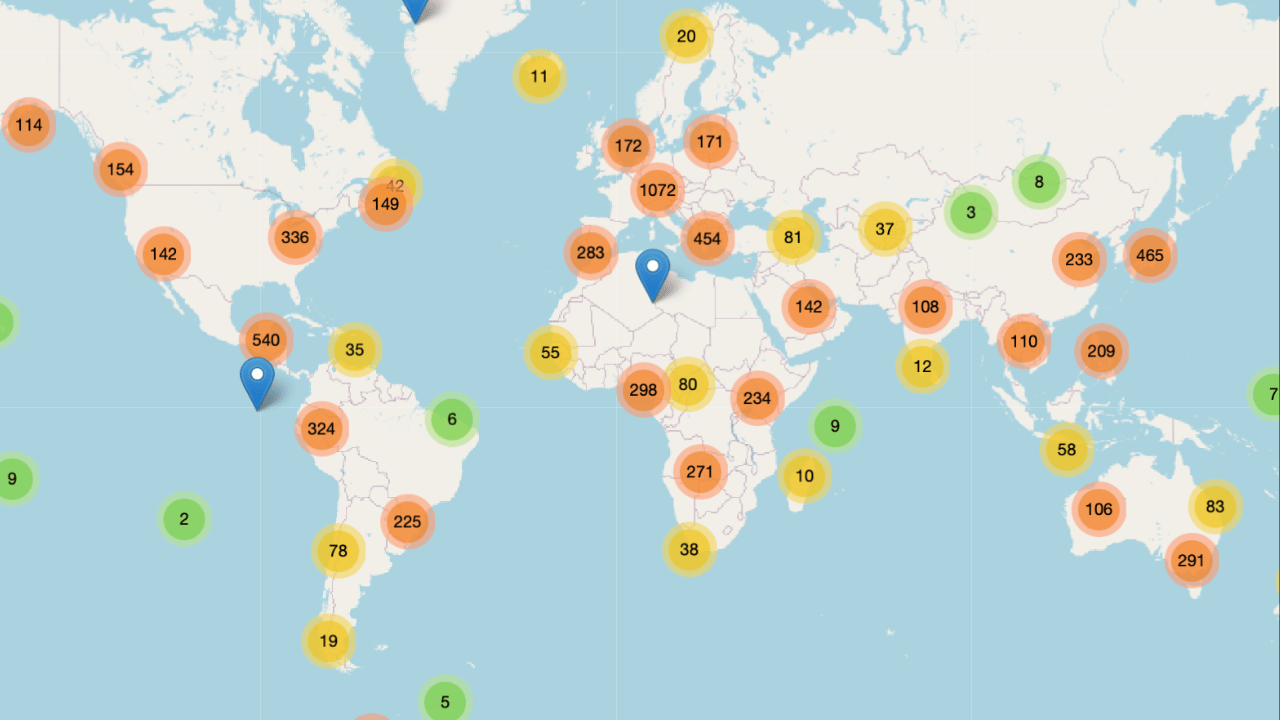
Get access to the world’s best photography location map - explore tens of thousands of amazing photo spots across the globe!
Photographer of the Week
Photographer of the week goes to: Dave
You can find him on Instagram as: @dv3pix
A few photos of his:


*advertisement
Learn AI in 5 minutes a day

What’s the secret to staying ahead of the curve in the world of AI? Information. Luckily, you can join 1,000,000+ early adopters reading The Rundown AI — the free newsletter that makes you smarter on AI with just a 5-minute read per day.
The Rest of this Issue is for Premium Subscribers
